USP & Pharmacopeia
Static, Air, Heat, and Hands: The Four Things That Beat a Good Balance
A practical look at why high-resolution weighing depends on the room, the sample, the operator, and the record - not only the balance.
By Radwag USA · July 1, 2026 · 5 min read
A good balance can be calibrated, leveled, clean, and still lose the measurement.
That sounds strange until the weighing process is treated as a complete system. The balance is one part of that system. The room is another. The sample, the vessel, the operator, and the record also matter.
In high-resolution weighing, four ordinary forces can create serious problems: static, air, heat, and hands.
These are not side issues. They are often the difference between a number that only appears stable and a result that can be repeated, defended, and used.
Why a Good Balance Can Still Give Weak Data
When a lab discusses readability, minimum weight, repeatability, or quality control, the conversation often starts with the instrument. That makes sense, but it should not stop there.
The real question is not only, "How fine can the balance read?" The better question is, "What is happening around the balance while it reads?"
RADWAG's own minimum weight discussion points to this same idea: installed conditions, airflow, temperature, humidity, static charge, handling technique, and environmental monitoring all affect the final result. A catalog value can help with selection, but actual performance depends on the balance as it is installed and used.
That is why static, air, heat, and hands deserve attention before a lab blames the instrument.
Static: The Invisible Pull
Static charge is one of the easiest weighing problems to miss because it does not need to make noise or leave a mark.
Plastic containers, glassware, filters, powders, weighing boats, and low-humidity rooms can all contribute to charge. When charged material is near the weighing pan or chamber, it can create attraction or repulsion. The result may look like drift, slow stabilization, poor repeatability, or readings that seem to move without a clear reason.
This is especially important for analytical balances, microbalances, filter weighing, powder work, and small samples where a tiny force can become visible in the result.
RADWAG addresses this in several ways. The DJ-04 and DJ-05 antistatic ionizers are designed to neutralize electric charge around the load, the balance elements, and the weighing environment. Selected XA 5Y.A balances also include a built-in antistatic ionizer in the weighing chamber, so charge control becomes part of the weighing workflow instead of a separate afterthought.
The practical takeaway is simple: if a sample is clinging, drifting, settling slowly, or behaving differently from one weighing to the next, static should be checked early.
Air: The Room Is Part of the Measurement
A draft shield is not decoration. It is a reminder that the room can weigh in.
Air movement from HVAC vents, opening doors, nearby traffic, a moving chamber door, or even a person leaning into the bench can disturb high-resolution weighing. Pressure, temperature, humidity, and air density can also affect the measurement environment. In routine work, this may look like unstable readings. In more demanding work, it can affect repeatability, minimum weight, and confidence in the final value.
This is why balance location matters. A stable table, a low-vibration area, distance from vents and direct sunlight, and enough acclimatization time after moving the instrument are all part of the measurement process.
RADWAG 5Y balances bring this conversation onto the screen. The Digital Weighing Auditor on PS 5Y balances is described as checking whether the balance is ready for use and supporting real-time air buoyancy compensation. That matters because air is not just background. At high resolution, it becomes part of the method.
Heat: When Temperature Becomes a Force
Heat creates weighing trouble because temperature differences create movement.
A warm container placed on a balance can create convection currents. A cold sample can change while it sits in the room. Direct sunlight can warm one part of the chamber. A vessel held too long by hand can carry body heat into the measurement. Even if the balance is working properly, the sample and surrounding air may not be settled.
This is one reason acclimatization matters. Samples, containers, calibration weights, and the balance itself should be given time to reach stable conditions when the work requires reliable small-mass results.
RADWAG tools can support this discipline by helping labs observe conditions instead of guessing. The THB-R system is designed for monitoring and registering indoor ambient conditions, including air temperature, relative humidity, atmospheric pressure, vibration, and calculated air density. On compatible balances, ambient condition screens and records help connect a result to the conditions in which it was produced.
The important point is not that every weighing task needs a full environmental study. The point is that temperature should not be ignored when results are tight, drifting, or being used for decisions.
Hands: The Human Factor
The operator can protect the result or disturb it.
Hands affect weighing through more than simple mistakes. They affect it through habits: touching vessels directly, loading off-center, leaving chamber doors open too long, rushing stability, changing tare containers, using different sample transfer tools, or skipping a warning because the display looks close enough.
Two trained people can use the same balance and get different results if their technique is different.
This is where a balance platform can support better habits. RADWAG balances can help with user profiles, measurement history, audit trail workflows, prompts, stability indicators, and warning or blocking modes tied to method control. These tools do not replace training. They make good technique easier to repeat and easier to review.
For minimum weight work, that matters. The smallest valid sample is not only about the balance specification. It is about the operator, the setup, the vessel, the environment, and the method being consistent enough for the number to mean something.
Before You Trust the Number
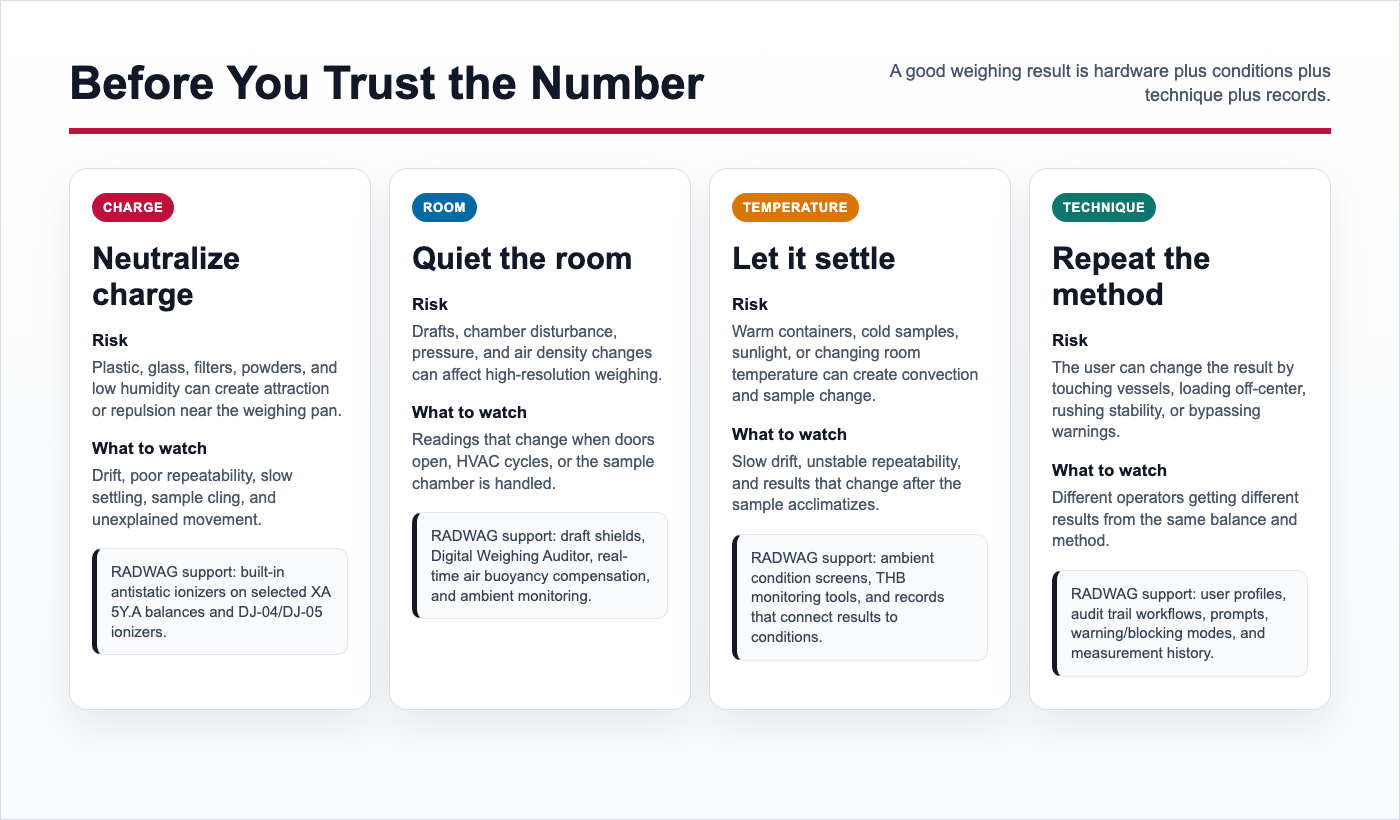
Before accepting a difficult weighing result, a lab can ask five practical questions:
- Was static controlled, especially with plastic, glass, filters, powders, or low humidity?
- Was air movement controlled, including doors, vents, chamber movement, and nearby activity?
- Were the balance, sample, vessel, and weights at stable temperature?
- Was the same handling technique used each time?
- Was the method documented well enough to explain the result later?
This is the difference between weighing as a quick action and weighing as a controlled process.
The Better Way to Think About a Balance
A balance gives capability. A method protects that capability.
Static, air, heat, and hands can beat a good balance because they act directly on the same thing the balance is trying to measure: small changes in force and mass behavior. When those variables are controlled, the balance has a better chance to do what it was designed to do.
That is the value of connecting RADWAG balances, ionization, environmental monitoring, readiness checks, minimum weight tools, user controls, and records into one practical workflow. The result is not just a better number on the display. It is a stronger reason to trust the number after the display changes.
Reference links: