USP & Pharmacopeia
Setting a RADWAG Balance for Reliable Minimum Weight
How environment, repeatability, method limits, and minimum weight functions shape a controlled weighing threshold.
By Radwag USA · June 11, 2026 · 5 min read
Minimum weight is one of the most misunderstood concepts in analytical weighing. It is often confused with readability, minimum load, or the smallest number shown on the display. In practice, minimum weight is not simply the lowest value a balance can display. It is a working threshold tied to repeatability, method requirements, environmental conditions, tare or container use, and the quality system under which the balance is used.
For that reason, reliable minimum weight testing begins before the first measurement. It begins with the balance's intended use, the smallest net amount that the method requires, the weighing environment, the applicable standard or internal SOP, and the evidence needed to show that the balance remains fit for purpose.
Standards and Procedure Context
Minimum weight testing should be evaluated according to the standards, internal SOPs, and quality-system requirements that govern the actual weighing method. The applicable framework depends on the application: OIML may be relevant in legal-metrology contexts, USP may be relevant for compendial weighing, NIST may be relevant for traceability or Handbook 44 contexts, and ASTM practices may be relevant for calibration or mass-standard work.
The applicable framework depends on the balance application, the method, the operating environment, and the quality system. A laboratory, production facility, or calibration provider should confirm which standards and procedures govern the weighing process before defining minimum weight acceptance criteria.
Minimum Weight Is Determined From Performance
Minimum weight should be treated as a site-specific and method-specific value. It depends on the balance, its location, repeatability data, tare or container conditions, sample-handling technique, and the tolerance required by the method or quality system.
In USP-related discussions, minimum sample weight is often connected to repeatability data and the standard deviation of repeated measurements. A common technical approach uses repeated weighings to evaluate balance repeatability and establish a lower working threshold for the method. This does not mean that every site can use one universal number. Minimum weight is the beginning of a reliable measuring range under defined conditions, and those conditions can change.
RADWAG Minimum Weight Functions
Selected RADWAG balances include minimum weight functions that can help the user control weighing below a defined threshold. On supported systems, the function may require entry of the minimum weight value and tare value. The minimum mass is determined for a specific balance, in the place of use, and according to the specific method.
Some RADWAG workflows can use warning or blocking behavior. In a warning configuration, the balance can indicate that the current value is below the defined minimum weight while still allowing the operation to continue. In a blocking configuration, the system can prevent approval of a measurement below the defined value. The correct behavior depends on the site's risk control strategy and SOP.
Smart Min Weight indications on selected RADWAG analytical balances can support this workflow by showing whether the weight is below or above the defined minimum weight threshold. These functions can support a controlled workflow, but they should not be described as creating USP, OIML, NIST, or ASTM compliance by themselves. The organization still determines the minimum weight, documents the method, configures the balance, trains users, and reviews records.
Catalog Minimum Weight Is Not the Same as a Validated Site Value
RADWAG product information may list model-specific minimum weight values. These values are useful when comparing balance capabilities, but they should not automatically be treated as the laboratory's validated working value.
A laboratory still needs to verify performance under its own method, installation conditions, tare or container use, weighing technique, and SOP. A catalog value can help guide selection, but the actual working threshold should reflect the balance as installed and used.
The Setup Matters as Much as the Calculation
Minimum weight is sensitive to the real weighing environment. Small amounts are affected by air movement, unstable temperature, vibration, static charge, handling technique, and the condition of the balance. A balance with fine readability can still produce poor results if it is installed in an unstable location.
For high-resolution weighing, the work environment should be stable. A suitable setup may include a stable floor, robust weighing table, reduced airflow, protection from direct sunlight, controlled temperature and humidity, and enough acclimatization time after installation or relocation.
Environmental monitoring can support this control. Temperature, humidity, pressure, air density, and vibration can all influence weighing performance. When environmental data is monitored and reviewed, the laboratory has stronger evidence that minimum weight results were produced under controlled conditions.
This is a practical point for any minimum weight discussion: minimum weight is not only a calculation. It is a calculation supported by installation control, environmental monitoring, routine checks, and correct operator technique.
A Practical Minimum Weight Workflow
A reliable minimum weight procedure begins with the intended use of the balance and the smallest net sample weight required by the method. The laboratory confirms the applicable standard, internal SOP, acceptance criteria, balance calibration status, and operating range. The balance is placed on a suitable bench or weighing table in a controlled location, with attention to airflow, vibration, direct sunlight, static charge, temperature, and humidity. After installation, relocation, or major environmental change, the balance is allowed to acclimatize according to the site's procedure.
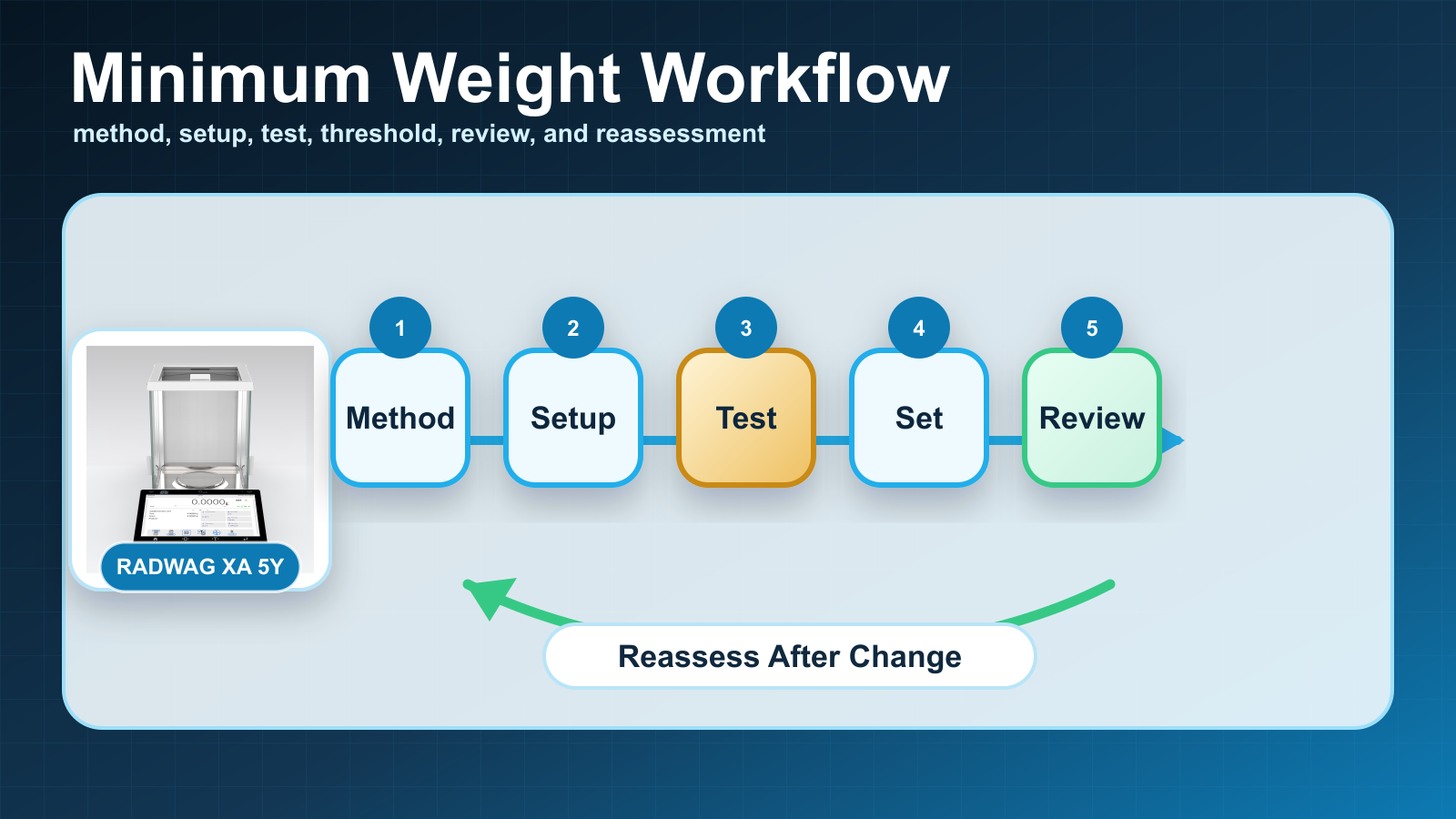
Minimum weight control is a workflow: method definition, setup, repeatability testing, threshold configuration, record review, and reassessment after change.
The laboratory uses suitable mass standards with appropriate class, calibration uncertainty, and documented metrological traceability. Repeatability testing is performed according to the approved method, and the minimum weight or minimum sample weight is calculated according to the SOP. Where the function is available, the minimum weight and tare conditions are entered into the balance. Warning or blocking behavior is selected according to the site's risk control strategy. The method, results, operator, balance ID, standards used, environmental conditions, and reviewer approval are recorded. Minimum weight is reassessed after relocation, service, environmental change, method change, or significant repeatability trend shift.
Records and Review
Where required by the quality system or applicable regulation, record handling matters. Written procedures must be established and followed, and relevant data must be retained and reviewed according to the applicable quality system.
This means the minimum weight procedure should define what happens when a sample is below threshold, when a warning is bypassed, when a block prevents approval, or when repeatability fails to meet the SOP. The exception path is as important as the normal path.
Final Technical Point
Reliable minimum weight testing is a combination of balance performance, installation control, method design, environmental stability, user training, and documented review. RADWAG minimum weight tools, Smart Min Weight indications, warning and blocking modes, and environmental monitoring accessories can support this workflow. The laboratory remains responsible for determining the working threshold, verifying or validating the procedure as required by its quality system, maintaining records, and reviewing performance over time.