Application Notes
What Changes When a Microbalance Is Built for Stent Weighing
How the XA 6.5Y.M.A.S supports stent weighing as a method: sample handling, Differential Weighing, series statistics, and clean data handoff.
By Radwag USA · June 16, 2026 · 6 min read
At RADWAG USA, we do not look at stent weighing as a single number on a display. The number matters. But the work begins earlier, with a delicate object that has to be supported and placed consistently, and it continues later, when the result has to be reviewed as part of a real process.
That is the part of the job that can disappear in a simple specification comparison. If a lab only looks at capacity and readability, a conventional microbalance can look like enough. In many cases, the instrument may be technically capable. It can have the resolution, chamber, display, and output a lab expects from a serious microbalance.
But a stent is not a simple sample. It is an open scaffold, built from thin struts, with length and diameter but very little mass. In coated stents, a small change in mass may represent material added to a difficult geometry: coating deposited across the surface, dried, inspected, or compared against a process target. The question is not only whether the balance can reach the reading. The better question is what the station helps the operator control before, during, and after that reading.
A capable balance can still leave the process outside the balance
In a general-purpose setup, the stent method often has to be built around the instrument. The lab still has to solve the support, the placement routine, the handling discipline, the notation method, and the review path.
This is where a basic weighing process becomes fragile. The balance may perform well, but the surrounding work can depend on fixtures, habits, spreadsheets, file names, and operator memory. Each of those decisions can be reasonable on its own. Together, they create a process that the lab has to keep reconstructing.
The difference is not between a balance that can weigh and one that cannot.
The difference is between using a capable balance for a difficult object, and using a station that was built around the object and the work that follows the reading.
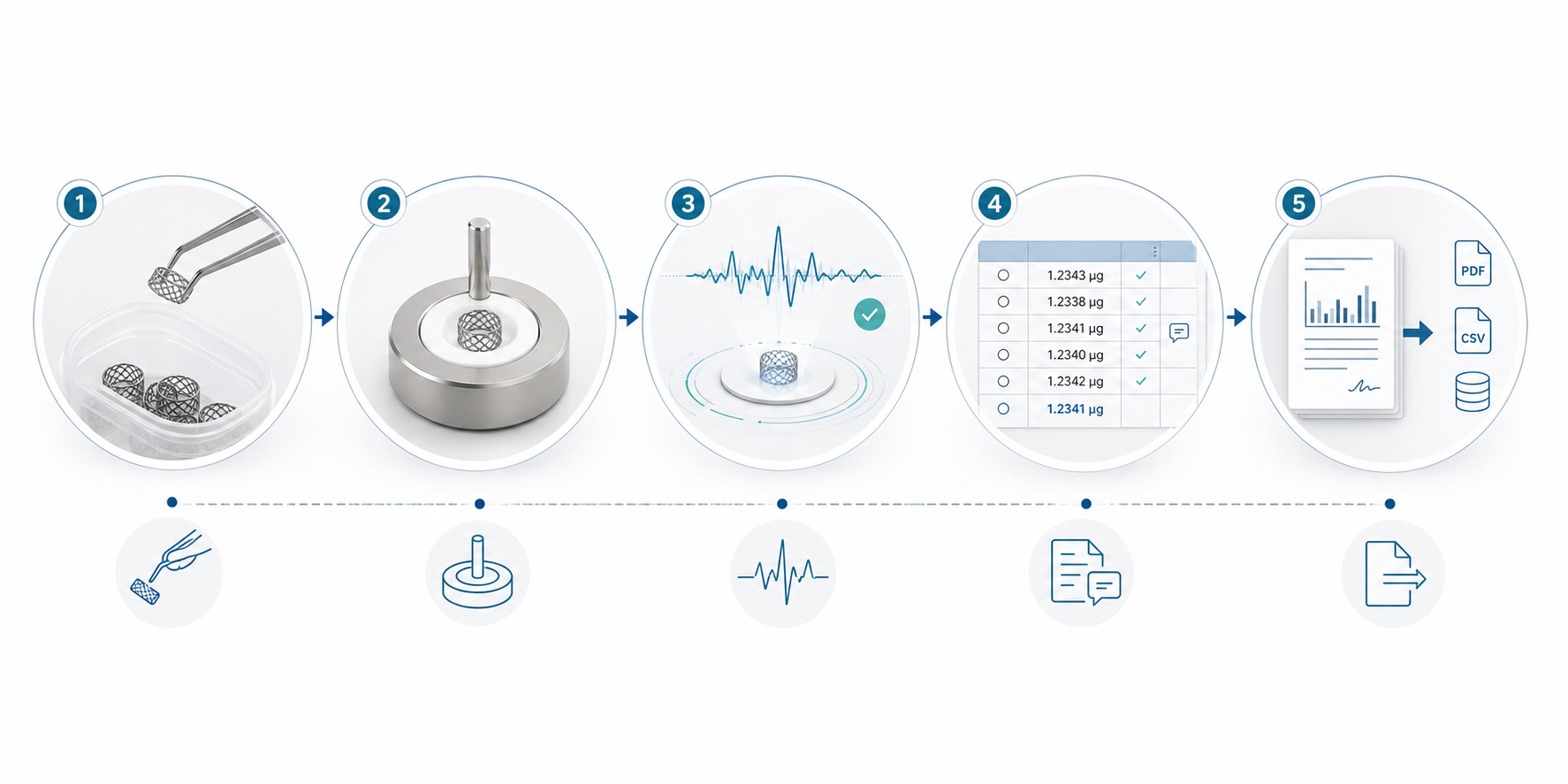
Moving more of the application into the station
The XA 6.5Y.M.A.S changes the starting point. The stent pans, holders, and glass covers are not accessories in the casual sense. They move part of the application into the station itself. The balance is no longer waiting for the lab to invent the stent-handling method around a standard pan.
That matters because the physical step is the first source of confidence. A stent needs a place to sit. It needs to be introduced into the weighing chamber without making the result harder to trust. It needs a repeatable way to be handled across a sample series, not just a one-time reading that looks acceptable on screen.
Once the sample is better supported, the software becomes part of the same idea. The station is not only protecting the object. It is helping the operator keep the stent tied to the process step around it: uncoated, coated, dried, cleaned, inspected, documented, or reviewed.
Software for the stent run, not just the reading
Differential Weighing and Statistics are not concepts around the balance. They are working modes inside the 5Y software. That matters because a stent workflow often needs more than a stable mass value. It needs a controlled way to keep the sample, the process step, the comparison, and the series together.
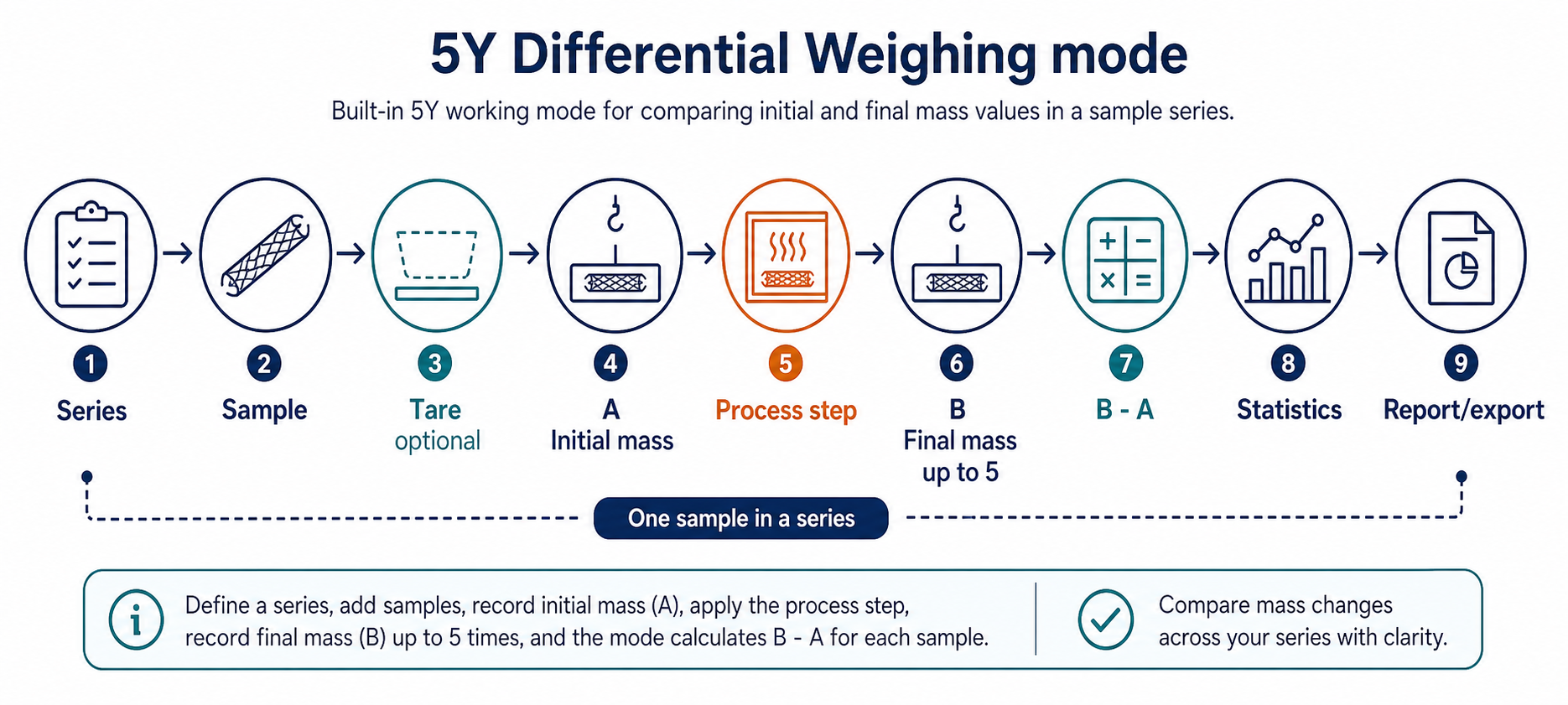
For a coated stent, this can mean recording the uncoated mass as Weighing A, moving the stent through a process step such as coating, drying, cleaning, or inspection, and then recording the final mass as Weighing B. The value of the mode is not only that it calculates B minus A. It keeps that comparison attached to the sample and the series where it belongs.
Statistics gives the run a second level of visibility. The operator can look at the behavior of the series, not only the individual readings: minimum, maximum, mean, standard deviation, and the spread of the lot. The balance is still doing precise weighing, but the software helps the user see whether the process is staying together.
Statistical Quality Control is also available in the 5Y software, but it is a separate working mode for configured product-control workflows. For this stent example, the core software path is Differential Weighing for the before-and-after comparison, followed by Statistics for the behavior of the series.
The software does not make the stent less delicate.
It keeps the weighing step aligned with the process.
The result has to travel
A weighing result does not end on the display. It becomes part of a batch record, a development note, a coating check, an inspection sequence, or a data file someone will review later. If the weighing station does not help carry that context, the team has to attach it somewhere else.
This is where the RADWAG system becomes more than a specialized pan. User verification can connect the operator to the action. RFID and databases can help connect the work to stored objects or products. Live Note keeps observations close to the measurement series or procedure report. ALIBI memory preserves the measurement date, time, result, tare, logged operator, and product name in the balance memory. Communication paths such as USB, Ethernet, Wi-Fi, Hotspot, and external software options help move the data forward.
None of this replaces a validated LIMS, MES, ERP, eQMS, or batch-record system. Mass-difference data supports the weighing method record; final acceptance and process validation remain governed by the lab's validated procedure and downstream quality system. The point is that the weighing step can carry more of its own context before those systems receive the result.
A short series after coating or inspection
Take a short series of stents moving through a coating step. In a basic setup, the operator may weigh each stent correctly, then rebuild the story afterward from an uncoated value, a coated value, a spreadsheet entry, a file name, and a note.
In a stent-focused RADWAG station, more of that story can stay attached to the weighing step. The physical setup supports the sample. Differential Weighing supports the before-and-after comparison. Statistics help the operator see the run. Records and notes help the next person understand what happened without asking the bench to reconstruct it later.
- Before the reading The sample is handled through a setup designed for the shape of the stent, not treated as a generic object on a standard pan.
- During the reading The station supports stable microgram weighing while the operator works inside a more application-specific setup.
- After the reading The result can remain closer to the sample series, note, report, and export path instead of becoming a number that has to be explained later.
What changes at the bench
The point is not that specifications stop mattering. They matter. Capacity, readability, repeatability, environment, and calibration discipline still set the foundation for the work.
For stents, the question is larger. Does the weighing station help the team protect the sample? Does it make the physical setup less improvised? Does it support the comparison the method actually requires? Does it keep the result closer to the sample, user, note, and report? Does it make the handoff cleaner for the person who reviews the work later?
That is why we do not see the XA 6.5Y.M.A.S as just another microbalance with a stent accessory. We see it as a stent weighing station: a way to bring the object, the measurement, and the data handoff into one more coherent step.
A stent weighing result is only as useful as the process that surrounds it. The value of a purpose-built station is that it helps that process begin before the number appears, and continue after the number leaves the display.