21 CFR Part 11
Trace Mass, Real Decisions: How the RADWAG UYA 5Y Changes the Meaning of a Weighing Result
A balance-industry article on ultra-micro weighing, filter evidence, differential mass change, and why the record behind a tiny result matters.
By Radwag USA · July 15, 2026 · 6 min read
A microgram does not look dramatic.
It does not fill a vial. It does not change the shape of a filter. It does not announce itself on a lab bench.
But in the right laboratory process, a small mass change can decide whether a filter captured enough material, whether a process is behaving consistently, whether a research sample changed after exposure, or whether a record is strong enough to be reviewed later.
That is where the RADWAG UYA 5Y ultra-microbalance becomes worth discussing. Not as a sales object, but as an example of where the balance industry is going: from displaying mass to supporting decisions around trace mass.
The Real Story Is the Difference
Ultra-micro weighing is rarely about the object alone.
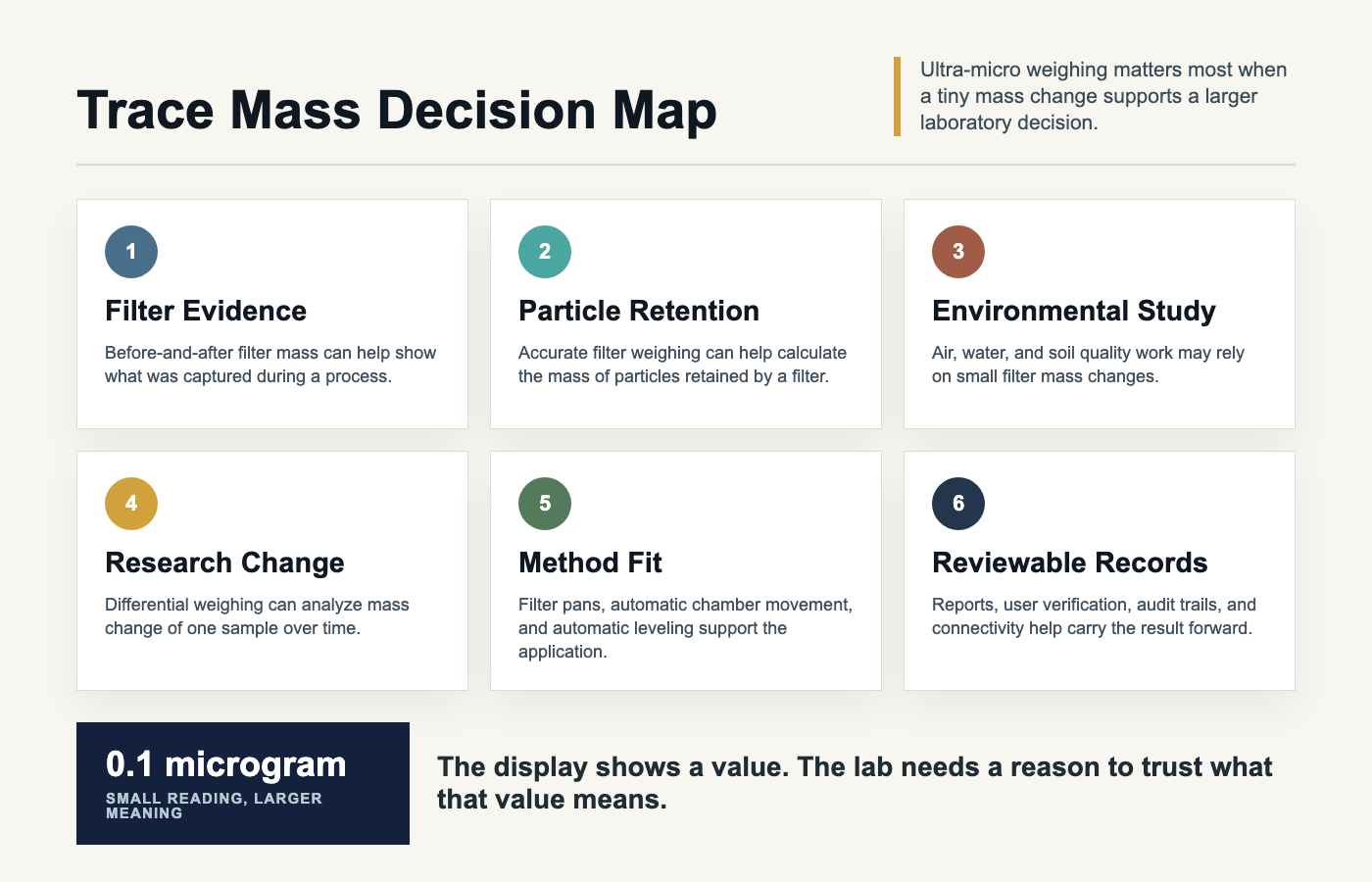
It is often about the difference between two moments: before and after filtration, before and after exposure, before and after drying, before and after processing, or before and after a controlled step in a research method.
RADWAG's ELLIPSIS working modes include differential weighing, described as analyzing the change in mass of a single sample over time. That point matters. In many labs, the most important value is not the first mass reading. It is the change that appears after something has happened to the sample.
This is why trace mass work has a different kind of importance. The sample may look unchanged, but the mass record can show the event.
The UYA 5Y in Plain Facts
The UYA 5Y line is listed with 0.1 microgram readability and maximum capacity options from 2.1 g to 6.1 g. RADWAG USA also lists the UYA 5Y ultra-microbalance category with a 0.3 mg lowest USP minimum weight, an automatic draft-proof weighing chamber, a fully automatic leveling system, and a weighing range up to 6.1 g.
Those facts are not just catalog details. They define the type of work being discussed. This is not general-purpose weighing with more decimal places. It is trace-mass weighing, where a small change can be tied to a quality result, a research conclusion, or a compliance record.
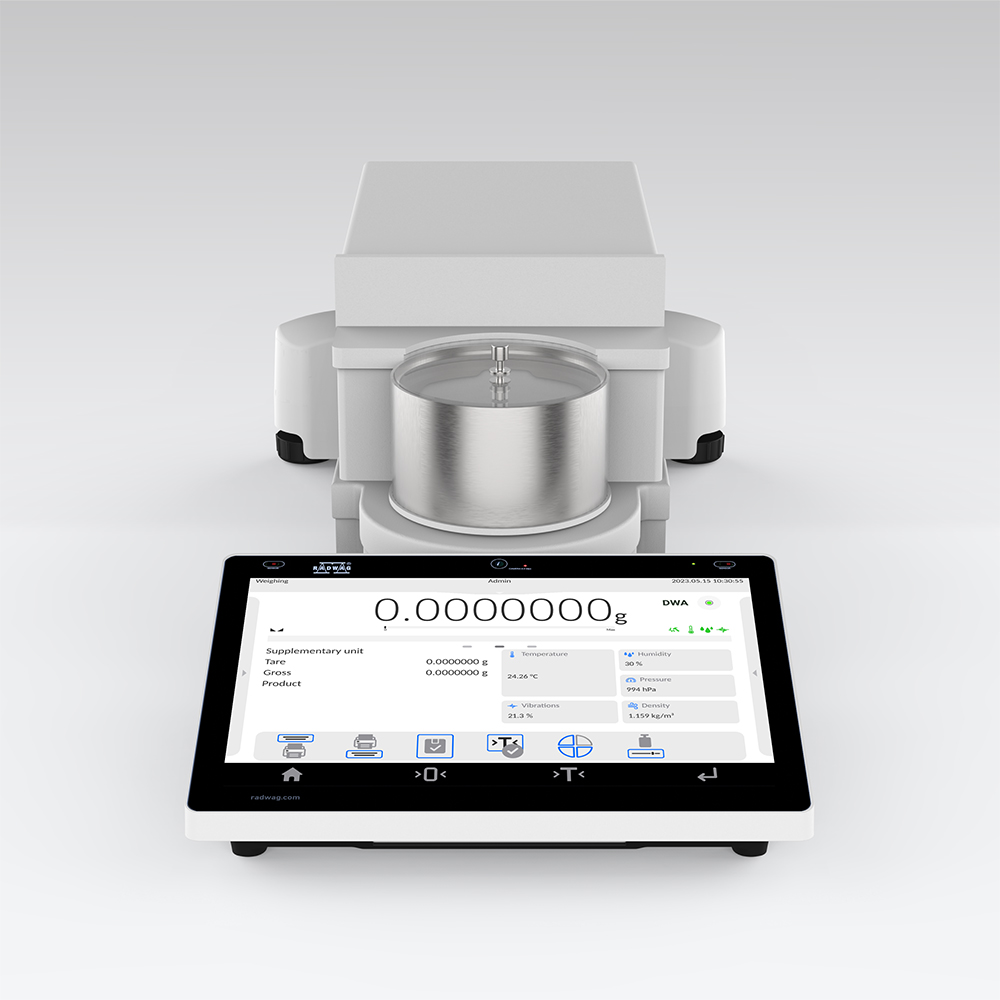
RADWAG describes the UYA ultra-microbalance as two components in separate housings: a weighing terminal and a precision mechanical measuring system. The purpose is to reduce the influence of temperature changes and mutual vibration transmission between components.
The UYA 5Y also uses automatic adjustment that records temperature changes and helps eliminate indication deviations caused by unstable working conditions. The standard anti-draft chamber, sliding side doors, glass/aluminum components, and recommended antivibration table with granite stabilizing plate all point to the same idea: ultra-micro weighing is built around protecting the measurement.
Filter Evidence Is the Best Example
The UYA 5Y.F makes the value of trace-mass weighing easier to understand.
RADWAG says the UYA 5Y.F is used for differential filter mass measurement with 0.1 microgram readability. In addition to a regular weighing pan, it includes a weighing pan for filters.
That matters because filter work is often about what the eye cannot judge. A filter can collect particles, residue, or material from a process and still appear visually ordinary. The mass record is what makes the difference measurable.
Filter weighing can support environmental laboratories working with air, water, or soil quality analysis. It can support emission studies, environmental protection, contamination checks, and process monitoring. It can also support quality control work where accurate filter weighing is used to assess filtration efficiency or calculate the mass of particles retained by a filter.
This is the kind of use case that makes ultra-microbalance work feel less abstract. The instrument is not only answering "how much does this weigh?" It is helping answer "what did this filter capture?"
Small Samples, Large Consequences
Trace-mass weighing can also matter outside filter work.
In pharmaceutical and chemical laboratories, a small mass can affect a formulation, an analytical result, or a quality decision. In research, small changes can appear after a material is dried, coated, exposed, cleaned, reacted, absorbed, desorbed, or compared across time.
The ELLIPSIS platform lists working modes that broaden the discussion beyond simple weighing. These include differential weighing, density, formulations, statistics, SQC, mass control, comparator, and pipette calibration support. Not every mode belongs to every UYA 5Y application, but the direction is clear: the balance is becoming part of the method, not just the place where a value appears.
RADWAG also points to accessories for microscale glassware, filter weighing, stent weighing, and pipette calibration support. That matters because modern lab weighing is becoming more application-specific. A balance is no longer judged only by its readability. It is judged by how well it fits the work around the sample.
The Benefit Is Fewer Loose Ends
The strongest benefit of a system like this is not only sensitivity.
It is fewer loose ends between the sample and the record.
The UYA 5Y.F includes an automatically opening weighing chamber using infrared gesture sensors. RADWAG states that this helps obtain more accurate measurement results. The ReflexLEVEL system provides automatic leveling. Digital Weighing Auditor ensures that the balance is ready for use, enables real-time air buoyancy compensation, and informs the user when inspection or periodic audit of accuracy and sensitivity is needed.
On the ELLIPSIS platform, DWA monitors ambient conditions, fully automatic leveling, adjustment, USP compliance, and ionizer operation. The audit result can be communicated through Ambient Light, home-screen pictograms, or a speaker.
For a lab, these features reduce ambiguity. They help answer questions that often come after a result is questioned: Was the balance ready? Was leveling correct? Was adjustment current? Was the method supported by the instrument status? Was the record complete enough to review?
The Data Path Matters as Much as the Pan
One of the most important shifts in the balance industry is that the weighing result no longer lives only on the display.
RADWAG describes the ELLIPSIS terminal as a 10-inch graphic color touchscreen that can show up to three screens, widgets, graphs, statuses, notes, and handy measurement history. The platform can connect to a smartphone or tablet through hotspot, to a spreadsheet through USB-C Free Link, to a printer, to a computer, to a barcode scanner, to a large screen by HDMI, to PC software, and to a keyboard and mouse.
That matters because a trace-mass result usually needs context. It may need a product ID, user ID, method, report, note, series, audit trail, or exported record. The easier it is to move from measurement to documentation, the less likely the result becomes an isolated number.
ELLIPSIS also includes user verification by password, RFID card, fingerprint reader, facial recognition, or combinations of those methods. RADWAG states that ELLIPSIS supports 21 CFR Part 11 / EU GMP Annex 11 as a standalone balance, including full data security, electronic signatures, validations, electronic records, and audit trails.
For regulated or review-heavy laboratories, that is not a side feature. It is part of the result's credibility.
What This Means for the Balance Industry
The balance industry has spent a long time talking about readability, capacity, repeatability, and stabilization. Those still matter, but the next question is bigger: can a balance help a lab turn a tiny value into a decision?
The RADWAG UYA 5Y is interesting because it sits at that crossing point. It brings 0.1 microgram readability into a system built around mechanical separation, automatic adjustment, a controlled chamber, automatic leveling, filter-specific hardware, readiness auditing, connected data paths, user verification, and compliance records.
That is the stronger way to think about ultra-micro weighing: not smaller numbers for the sake of smaller numbers, but smaller numbers that carry enough context to matter.
Source Links
- RADWAG UYA 5Y ultra-microbalance: https://radwag.com/en/uya-25y-ultra-microbalance%2Cw1%2C3L0%2C101-104-105-100
- RADWAG USA UYA 5Y.F filter ultra-microbalance: https://radwagusa.com/en/uya-25yf-ultra-microbalance%2Cw1%2CMIA%2C101-104-105-101
- RADWAG USA ultra-microbalances: https://radwagusa.com/en/ultra-microbalances%2C4%2C101-104
- RADWAG ELLIPSIS platform: https://radwag.com/en/ellipsis/