21 CFR Part 11
PM 5Y Precision Balances: The Balance Line That Gets Scale People Talking
A convention-style technical article for lab techs, QC teams, formulation groups, and people who appreciate high-capacity precision weighing.
By Radwag USA · June 24, 2026 · 4 min read
PM 5Y Precision Balances: The Balance Line That Gets Scale People Talking
Put the PM 5Y on a table at a lab convention and the first conversation would not be about a brochure. It would be about the unusual space this balance line occupies: heavier loads, real precision, large pans, fast stabilization, and enough data-control tools to make quality people stay at the booth.
That is what makes the RADWAG 5Y.PM line interesting. It is not a tiny analytical balance, and it is not a basic bench scale. It sits in the middle where lab work, production checks, parts counting, formulation, dosing, and documentation all start pulling on the same instrument.
The First Question: How Heavy, and How Fine?
The PM 5Y family covers models from 10 kg to 120 kg, with readability from 0.01 g to 0.2 g. The attention-grabbing point is the high-capacity precision range: RADWAG lists 0.01 g readability up to 20 kg and 0.2 g readability up to 120 kg.
For scale people, that matters because capacity and readability usually fight each other. A lab may need to weigh a heavy container, a large batch, an irregular component, or a multi-part assembly, but still want the confidence of a refined measurement process.
The PM 5Y conversation starts when someone says, "We need more capacity, but we cannot afford to lose control of the result."
Why the Pan Gets Attention
RADWAG describes the PM balances as supporting loads up to 120 kg on a large weighing pan with high accuracy and good repeatability. The line includes pan sizes adapted to the model, including 200 x 185 mm, 350 x 260 mm, and up to 400 x 500 mm for the largest models.
That is not just a size note. A larger pan changes what a lab can place on the balance. Containers, tooling, packaging samples, bulk materials, production parts, and awkward shapes can be weighed without forcing the operator into a poor setup. RADWAG also highlights minimum eccentricity error over the range and a built-in 4-point overload protection system.
What Would Make the Room Lean In
The PM 5Y line uses enhanced MONO BLOCK technology. RADWAG states that this measuring system supports quick and stable measurement, with stabilization achievable within 1 second under stated conditions, internal adjustment, parameter stability over time and during transport, and resistance to ambient-condition changes.
Model Range
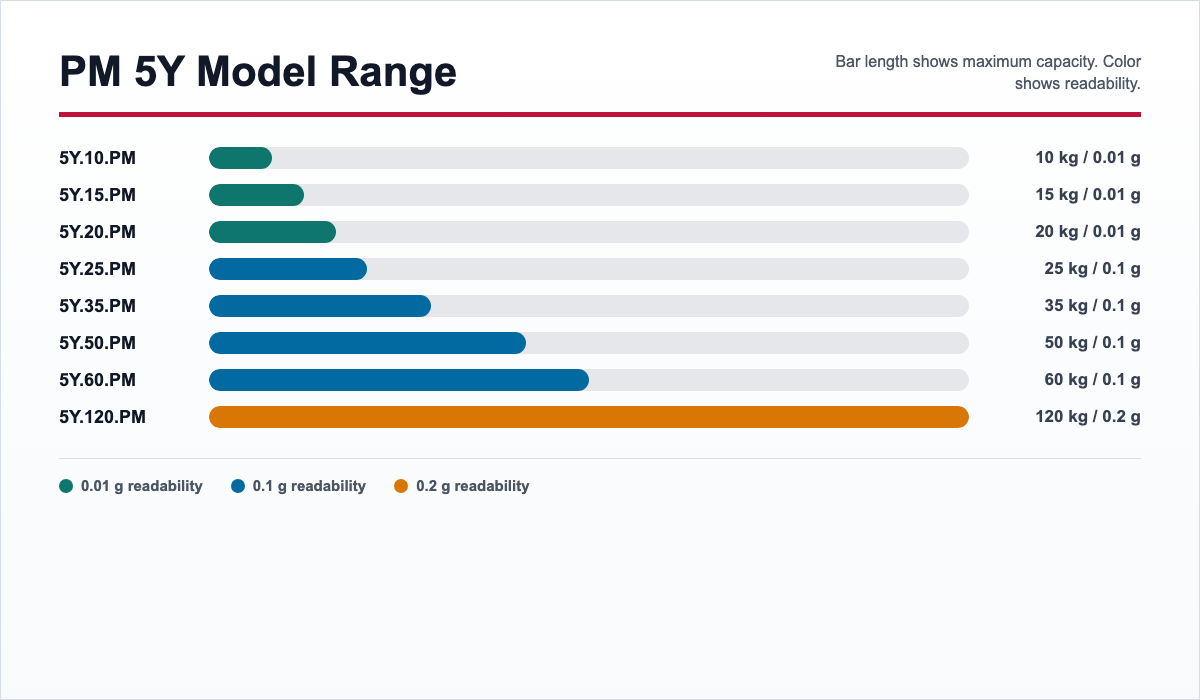
The graph shows maximum capacity by model. Color indicates readability.
| Model | Maximum capacity | Readability | Pan size |
|---|---|---|---|
| 5Y.10.PM | 10 kg | 0.01 g | 200 x 185 mm |
| 5Y.15.PM | 15 kg | 0.01 g | 200 x 185 mm |
| 5Y.20.PM | 20 kg | 0.01 g | 200 x 185 mm |
| 5Y.25.PM | 25 kg | 0.1 g | 350 x 260 mm |
| 5Y.35.PM | 35 kg | 0.1 g | 350 x 260 mm |
| 5Y.50.PM | 50 kg | 0.1 g | 350 x 260 mm |
| 5Y.60.PM | 60 kg | 0.1 g | 400 x 500 mm |
| 5Y.120.PM | 120 kg | 0.2 g | 400 x 500 mm |
The 5Y Side of the Story
RADWAG lists a 10-inch touchscreen, intuitive operation, Digital Weighing Auditor, multi-step user verification, Ambient Light alerts, Hotspot, RFID, Live Note text notes, measurement history in the Handy Library, and widgets as part of the 5Y.PM balance feature set.
Those features matter because a good balance experience is not only the number on the display. It is how quickly the operator gets to the right mode, how clearly the balance shows status, how records are protected, and how easily the result moves into the lab's workflow.
Where the PM 5Y Fits in Real Work
RADWAG points to dosing, formulation-making, and parts counting as typical PM 5Y applications. In practice, that gives the line a wide audience: formulation benches, incoming material checks, QC stations, production-support labs, packaging checks, research groups, academic labs, and any place where large samples still need disciplined measurement.
The interesting use case is not just "weigh something heavy." It is a lab that needs to weigh something heavier without dropping the habits that make laboratory weighing trustworthy: centering the load, checking stability, documenting the method, using the right mode, and keeping records that can be reviewed later.
Connectivity Changes the Conversation
The 5Y.10.PM product page lists USB-A, USB-C, RS 232, HDMI, Ethernet, Wi-Fi, and Hotspot. RADWAG's Ellipsis information also describes connecting to spreadsheets through USB-C with Free Link, printers, computers, barcode scanners, large screens, and PC software through the RADWAG communication protocol.
That is the kind of detail a lab tech remembers after the convention. A balance that can send data, support peripheral devices, display status clearly, and work with digital records fits better into a modern lab than one that only prints a final mass.
The Compliance Angle Without the Drama
For pharmaceutical and regulated environments, RADWAG states that 5Y.PM balances support 21 CFR Part 11 / EU GMP Annex 11. The product page connects this to data security, electronic signatures, validations, electronic records, and audit trails.
That does not make the balance useful only for pharma. It means the platform was built with record control in mind. Even a non-regulated lab can benefit from clearer user identity, cleaner history, and stronger documentation habits.
A Better Way to Think About the PM 5Y
The PM 5Y is best understood as a bridge between laboratory precision and heavier day-to-day weighing. It gives teams room for larger containers, bigger samples, and production-side checks while keeping the focus on stability, repeatability, workflow, and records.
For labs that need dependable results, that balance matters. As samples get bigger and the work gets busier, the weighing process still needs to stay controlled. That is the real reason the PM 5Y deserves attention in a serious lab conversation.
Reference: RADWAG USA 5Y.10.PM product page