ISO Standards
One Gram on a 300 kg Platform: Why the HY10.300.HRP Makes Scale People Look Twice
A balance-and-scale article on high resolution industrial weighing, MONOBLOCK measurement, protected construction, ALIBI records, and why gram-level visibility matters far beyond the lab bench.
By Radwag USA · July 22, 2026 · 5 min read
Some scale specifications are easy to pass over until the numbers land together.
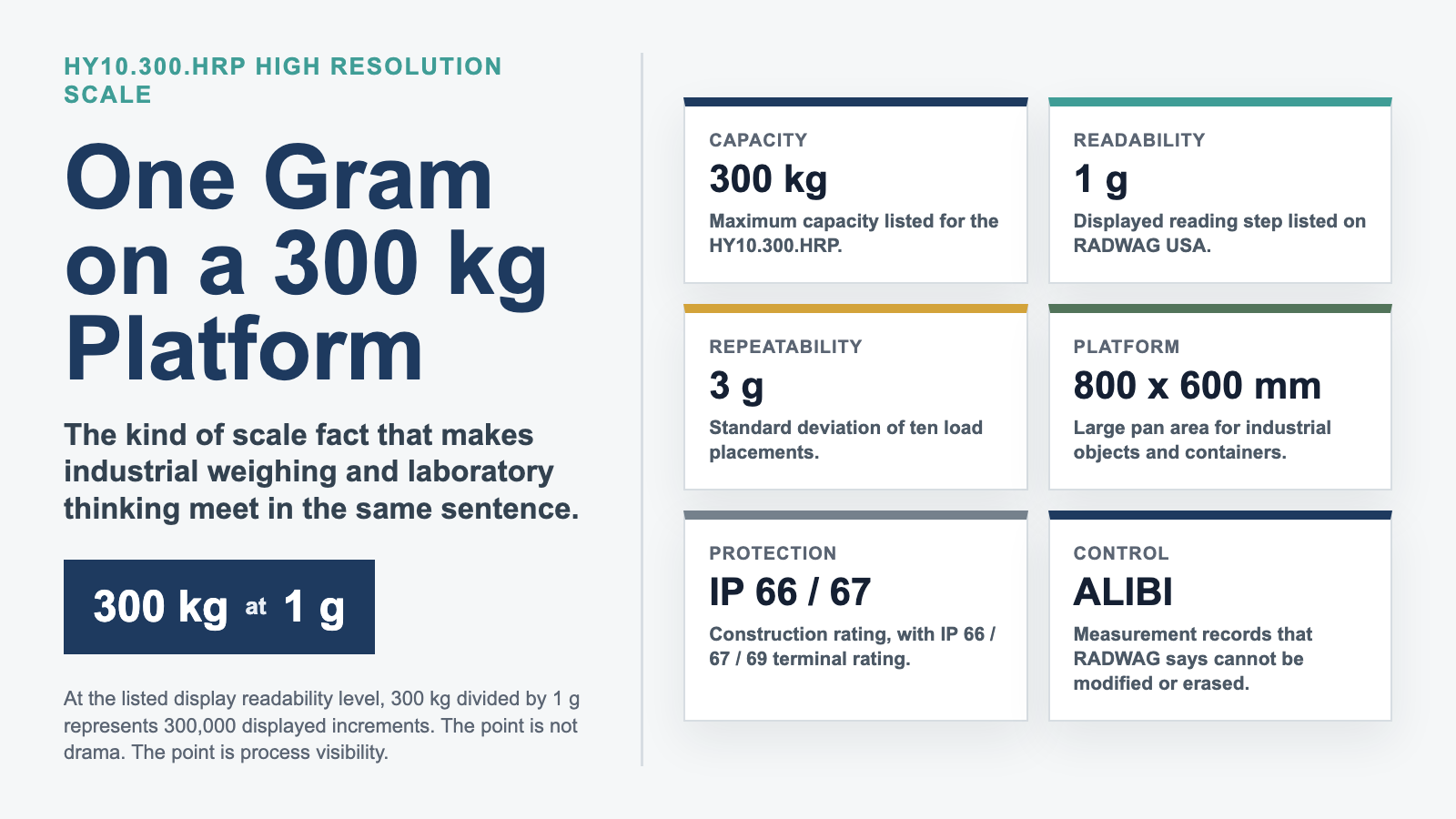
The RADWAG HY10.300.HRP is listed with a 300 kg maximum capacity and 1 g readability. That means an industrial platform large enough for serious loads is still giving the operator gram-level visibility.
That is not a normal way people think about floor weighing.
A laboratory balance is expected to care about fine changes. An industrial scale is expected to survive load, motion, cleaning, containers, pallets, and production work. The HY10.300.HRP belongs in the second world, but it brings a piece of the first world with it.
That is what makes it worth a closer look.
The Number That Changes the Room
Three hundred kilograms is a production number.
One gram is a method number.
Put them together and the conversation changes. A team is no longer only asking, "Can this platform hold the load?" The better question becomes, "What can be seen inside the load?"
At the listed display readability level, 300 kg divided by 1 g equals 300,000 displayed increments. That is a simple calculation, not a separate certification claim. But it explains why the HY10.300.HRP is interesting to people who understand scales. The capacity is big, yet the reading step is small enough to expose changes that rougher industrial weighing could hide.
What the HY10.300.HRP Actually Is
The HY10.300.HRP is a high resolution industrial scale from RADWAG's HRP line. The model listed on RADWAG USA has product code WP-330-0003.
The key datasheet facts are direct:
- Maximum capacity: 300 kg
- Readability: 1 g
- Minimum load: 50 g
- Preload range: 60 kg
- Tare range: -300 kg
- Repeatability: 3 g
- Linearity: +/- 6 g
- Stabilization time: 3 seconds
- Adjustment: internal automatic
- Weighing pan: 800 x 600 mm
- Display: 10.1-inch graphic color touchscreen
- Construction protection: IP 66 / 67
- Terminal protection: IP 66 / 67 / 69
- Pan material: stainless steel AISI304
- Construction: mild steel St3S
Those numbers describe a scale built for heavier objects, but not for careless weighing. A 50 g minimum load, 60 kg preload range, internal automatic adjustment, 3 g repeatability, and 1 g readability all point to a system where the operator can look at a process with much more detail than a normal industrial scale conversation allows.
The Measurement System Is the Story
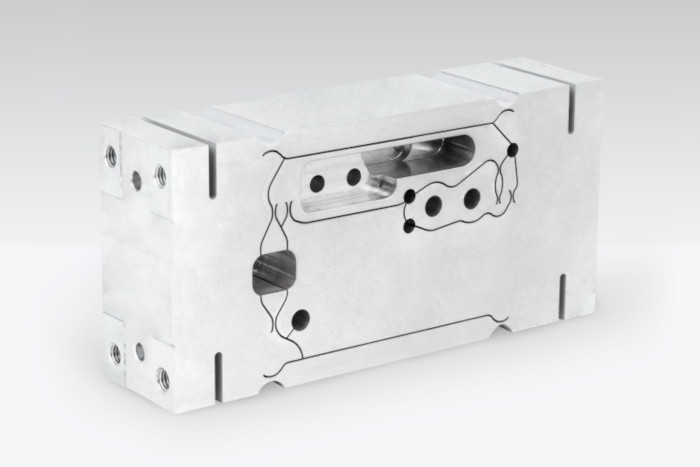
RADWAG connects the HRP line to improved MONOBLOCK technology. The point is not only that the platform is strong. The point is that the measurement system is designed for high readability, good repeatability, minimal eccentricity error across the range, fast and stable measurement, and stability of parameters over time and after transport.
That matters because industrial weighing does not happen in perfect silence.
Loads may be large. Containers may sit off center. Operators may work quickly. Cleaning may be frequent. The platform may live near mixers, fillers, drums, bins, pallet movement, and wet surfaces.
The HY10.300.HRP is interesting because it does not treat those conditions as an excuse for vague weighing. It keeps the discussion technical.
A Factory Floor Is Not a Quiet Lab
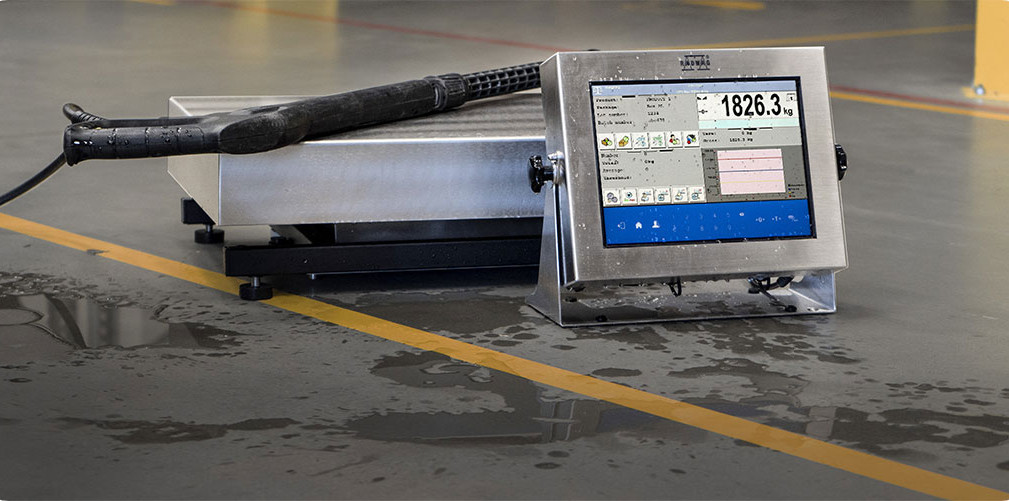
The HRP platform is listed with IP 67 protection, with added sealing elements against dust and moisture. RADWAG states that HRP scales can be cleaned with a pressure washer.
For the HY10.300.HRP, the datasheet lists IP 66 / 67 protection for the construction and IP 66 / 67 / 69 protection for the terminal. The PUE HY10 terminal is housed in stainless steel and uses a 10.1-inch color graphic touchscreen.
That combination matters in food, chemical, pharmaceutical, and other production environments because the scale is not just asked to weigh. It has to remain usable when the work area is cleaned, when materials are moved, and when operators need the screen to be readable in real workflow conditions.
The Terminal Turns Weight Into a Process
The PUE HY10 terminal gives the scale more than a display.
RADWAG lists the HY10 terminal with 2 x RS232, 2 x USB-A, Ethernet, and 4 IN / 4 OUT digital communication. Optional modules include Wi-Fi 802.11 b/g/n, RS485, Profibus, PROFINET, analog output, and 12 IN / 12 OUT.
That matters because many industrial weighing problems are not solved by the weight value alone. The value has to move to a label printer, scanner workflow, receiving system, production record, control system, or quality file.
The same page lists working modes including parts counting, checkweighing, percent weighing, animal weighing, formulations, differential weighing, labelling, peak hold, and statistics. That range says something important: this platform can act as part of a method, not only as a stop-and-read scale.
Where This Gets Interesting in Real Work
In a formulation room, gram-level visibility on a 300 kg platform can help teams watch ingredient additions without constantly changing equipment.
In food production, it can support controlled batching where small overages become real cost over time.
In chemical work, it can help monitor powder, liquid, and loose-material dosing against a defined tolerance.
In packaging, checkweighing and plus/minus control can help operators see whether a filled container, kit, or carton is inside limits.
In receiving or staging, a large pan and high resolution can help compare containers, totes, drums, or components without losing the smaller differences that explain process variation.
In quality control, differential weighing and statistics can turn repeated measurements into evidence instead of scattered numbers.
For people who love scales, that is the interesting part. The HY10.300.HRP is not impressive only because it can weigh heavy things. It is impressive because it makes heavier weighing behave more like controlled measurement.
The Record Behind the Result
RADWAG describes ALIBI memory as a record of measurements taken on the device that cannot be modified or erased. The function description says ALIBI memory can save up to 100,000 measurements and can record measurement date, measurement time, result, tare value, logged-in operator, and product name.
That matters when a weighing result has to survive a later question.
What was weighed? When? By whom? With what tare? Under which product name? If the answer is only written on paper or remembered after the shift, the result becomes weaker. When the scale holds the record, the number has a better chance of staying connected to the process that produced it.
The Quiet Detail Scale People Notice
The HY10.300.HRP has an 800 x 600 mm pan, internal automatic adjustment, a 3 second stabilization time under optimal conditions, 3 g repeatability, and +/- 6 g linearity. It operates from +10 to +40 degrees C with 15% to 80% relative humidity under non-condensing conditions.
Those details do not belong in a flashy headline, but they are exactly what experienced scale people look for. The headline grabs attention. The datasheet decides whether the attention is deserved.
This is why the HY10.300.HRP is a strong article subject. It does not ask the reader to be impressed by a buzzword. It asks the reader to think about what happens when a production platform starts giving the kind of detail that usually belongs closer to the lab.
The next time someone says "industrial scale," the HY10.300.HRP makes the obvious follow-up question harder to ignore:
How much of the process can the scale actually let you see?
Source Links
- RADWAG USA HY10.300.HRP product page: https://radwagusa.com/en/hy10300hrp-high-resolution-scale%2Cw1%2C46D%2C102-124-106
- RADWAG USA weighing terminals page: https://radwagusa.com/en/indicators-and-terminals%2C4%2C109
- RADWAG USA HY10.HRP function reference page: https://radwagusa.com/en/hy101100hrp-high-resolution-scale%2Cw1%2CFLX%2C102-124-106