21 CFR Part 11
21 CFR Part 11 Controls on RADWAG Balances: Audit Trail and E-Signatures
How user permissions, audit trail records, electronic signatures, and documented procedures support controlled weighing records.
By Radwag USA · June 11, 2026 · 5 min read
Electronic weighing records are valuable only when they can be trusted. In regulated environments, weighing results may be incorporated into FDA-regulated records depending on applicable predicate rules and site practice. When electronic records and electronic signatures are used in place of paper records and handwritten signatures under FDA-regulated requirements, 21 CFR Part 11 may apply.
Part 11 should not be treated as a feature of a single instrument. It is a regulatory framework for electronic records and electronic signatures. A balance, terminal, or software module can provide technical functions that support a Part 11 program, but compliance depends on the broader system: user management, validation, SOPs, training, record retention, access control, audit trail review, backup, and the organization's predicate-rule requirements.
This careful framing matters. RADWAG offers modules and software functions that can support controlled electronic records, while the complete compliance outcome depends on the regulated organization's validated process and quality system.
What Part 11 Covers
21 CFR Part 11 defines criteria under which electronic records, electronic signatures, and handwritten signatures executed to electronic records may be considered trustworthy, reliable, and generally equivalent to paper records and handwritten signatures. It applies when electronic records are created, modified, maintained, archived, retrieved, or transmitted under FDA records requirements, and in certain cases when electronic records are submitted to FDA.
For in-scope closed systems, Part 11 includes controls intended to support authenticity, integrity, confidentiality where appropriate, and non-repudiation of signed records. These controls include system validation, accurate and complete record copies, record protection, restricted access, secure time-stamped audit trails, operational checks, authority checks, appropriate device checks, training, written accountability policies, and documentation controls.
FDA guidance also emphasizes scope. Part 11 remains in effect, but regulated organizations must determine which records are Part 11 records based on predicate rules and actual business practice. This is why a weighing instrument can support a Part 11 workflow without replacing the need for a validated process and written procedures.
RADWAG Functions That Support Controlled Records
RADWAG offers 21 CFR Part 11 module options for selected instrument families. These modules are intended to support users who need controlled electronic records and electronic signature functions in regulated environments.
Depending on the model, module, and configuration, technical controls may include advanced password settings, login control, permission levels, controlled access to data management, backup, electronic signature functions, automatic logout, and modification records in an Audit Trail file. These functions map to common Part 11 control themes: unique users, controlled access, password management, traceable activity, signature capture, and reviewable records.
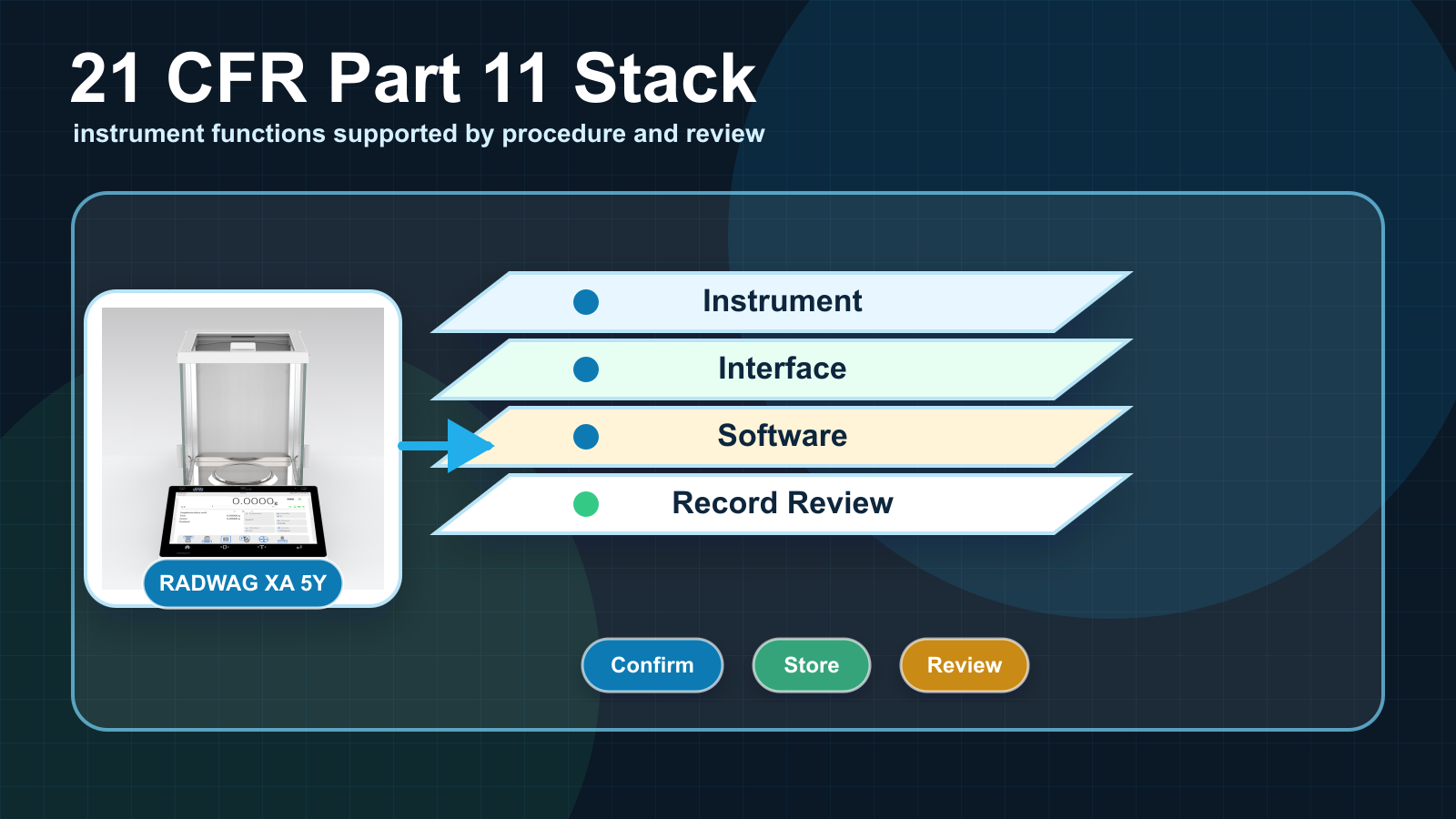
Device functions support the controlled-record workflow, while validation, SOPs, training, access rules, backups, and review remain part of the broader validated process.
The technical function should still be framed as support for a compliance program, not as a stand-alone compliance result. RADWAG modules can provide technical functions that support a 21 CFR Part 11 compliance program when implemented with appropriate SOPs, validation, training, access control, and record-retention procedures.
Audit Trail: What It Records and Why It Matters
For in-scope closed systems, 21 CFR Part 11 identifies secure, computer-generated, time-stamped audit trails as a control for independently recording the date and time of operator entries and actions that create, modify, or delete electronic records. Record changes must not obscure previously recorded information, and audit trail documentation must be retained and available for review according to applicable requirements.
On RADWAG systems with Audit Trail functionality, the audit trail can support review of balance-setting changes, database-record changes, and user activity. This can include information about who logged in, who changed a record, who signed a document, and when the action occurred, depending on the model, installed module, and configuration.
Audit Trail Reader extends the review workflow by allowing audit trail logs to be displayed and reports to be generated in common business formats. Audit Trail should not be presented as making records compliant by itself. The accurate claim is that Audit Trail functionality can help document user activity and record changes. The regulated organization remains responsible for determining which records are subject to Part 11 and for maintaining required controls.
Electronic Signatures and User Accountability
Part 11 includes requirements for signed electronic records and electronic signatures. Signed electronic records must show the signer, the date and time of signing, and the meaning associated with the signature, such as review, approval, responsibility, or authorship. Electronic signatures must also be linked to their related records so that they cannot be copied or transferred to falsify a record by ordinary means.
For non-biometric electronic signatures, Part 11 requires at least two distinct identification components, such as an identification code and password. Controls around uniqueness, password management, loss management, unauthorized-use protection, and device testing may also be relevant depending on the system.
RADWAG module functions, including permission levels, password settings, electronic signature, automatic logout, and Audit Trail records, can support this type of controlled user workflow. However, electronic signatures should not be described as legally valid in every context simply because an instrument can capture them. Where Part 11 applies, signature validity depends on the broader system and the organization's policies, identity verification, accountability controls, training, and record/signature linking.
Why the Balance Alone Does Not Create Compliance
The most important compliance point is also the simplest: Part 11 compliance is not purchased as a single feature. A device or weighing system alone does not create compliance. The implementing organization also needs SOPs, trained personnel, validated processes, record-retention procedures, access management, and periodic review.
That distinction keeps the technical claim precise. The balance can provide controlled functions. The organization defines the records, validates the process, trains users, controls access, reviews audit trails, retains records, and documents exceptions.
Practical Implementation Checklist
A regulated laboratory or production site should evaluate the complete workflow. The organization defines which weighing records are governed by predicate rules and documents whether electronic records or paper records are authoritative. It confirms the RADWAG model, terminal, and installed module, then configures unique users, permission levels, password rules, and automatic logout.
The quality system defines when electronic signatures are required and what each signature means. Audit Trail scope and report-export procedures are confirmed. Data transfer, storage, backup, and record retrieval are validated. Users and administrators are trained on SOPs. Audit trails and exceptions are reviewed according to a written procedure, and the configuration is reassessed after software, process, user-role, or record-retention changes.
RADWAG balances and software modules can support controlled electronic weighing workflows. A stronger Part 11 workflow is built when the instrument functions are combined with validated processes, trained users, and a documented quality system.